


Wins
 Share
Share


Court of Appeal stays eviction, reverses summary judgment for commercial real estate seller/landlord, and vacates seller’s fee award
GMSR’s client agreed to buy a warehouse, but closing was extended due to the seller’s repeated delays in recording a subdivision map. Patiently waiting, the buyer agreed to lease the property pending recordation and invested millions of dollars in improvements.
During the ensuing two-year delay, the state tightened environmental regulations and the property’s market value increased. When the seller advised that the map was recorded, the buyer replied that under the new regulations, its purchase lender required a minor soil test. The seller refused to permit the test. The buyer asked for some reasonable additional time to obtain alternative financing or cash. The seller refused.
The buyer sued for breach of the implied covenant of good faith, demanding specific performance of the sale agreement and conveyance of title. The trial court granted summary judgment to the seller and awarded $800,000 in attorney’s fees. The buyer appealed.
Soon, the seller terminated the lease and sued to evict GMSR’s client. But GMSR obtained a writ of supersedeas staying eviction under Code of Civil Procedure section 916, successfully arguing that the automatic appellate stay barred any eviction while the implied-covenant claim, and title to the property, were disputed on appeal.
Months later, the Court of Appeal unanimously reversed. Adopting GMSR’s arguments, the court held that the buyer was not prohibited from conducting the test and a jury could find the seller “operated in bad faith and attempted to take advantage of” the buyer. The court reversed the $800,000 fee award and ordered trial on the implied‑covenant claim.
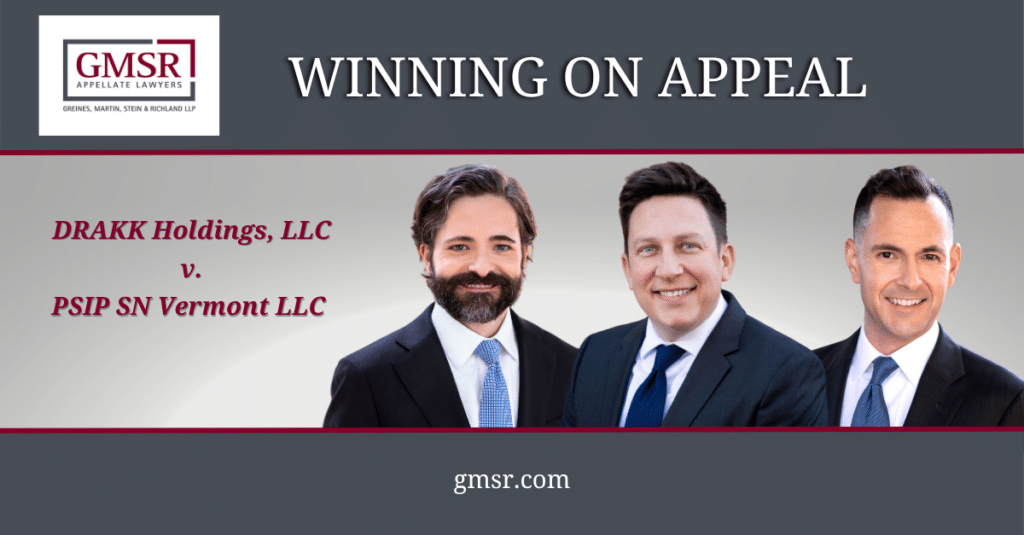
Click here to read the Court of Appeal’s opinion: DRAKK Holdings, LLC, v. PSIP SN Vermont LLC (June 23, 2026, No. B343318) 2026 WL 1802089 [Second District, Division Two].
Browse By Topic

© 2026 Greines, Martin, Stein & Richland LLP.
All rights reserved. Disclaimer - Attorney advertising. Prior results do not guarantee a similar outcome.
Los Angeles
6420 Wilshire Boulevard, Suite 1100
Los Angeles, California 90048
p: (310) 859 7811 | f: (310) 276 5261
San Francisco
50 California Street, Suite 1500
San Francisco, CA 94111
p: (415) 315 1774
Orange County
555 Anton Blvd, Suite 150
Costa Mesa, CA 92626
P: (310) 859-7811
We welcome your inquiry. However, sending us an email does not create an attorney-client relationship. For that reason, you should not send us any kind of confidential information. Until we have agreed to represent you, we cannot be obligated to keep it confidential.